(I asks what the trees dream of)
The leaves that they have cherished now fall down
Into a gently rotting golden veil
Which we draw over long and lazy days
And nights.
The sky is cloud-covered and stale,
As much as summer with its dying rays
Draws people out to bask while they still can
Like wasps, who always know when their time’s done,
And numb themselves accordingly.
The span
Of ripeness given by the earth has come
And gone, by now the over-softened fruit
Lies festering, alive and waiting for
The frost to come and sterilise it –
Moot
Whether the tiny lives on Warden’s Lawn*
Approve of their impending vanishing;
But when the freezing comes there’s no such thing
As wondering if it was such a good
Idea to stay around, unlike the birds,
Whose hasty exit’s waved and understood
By John’s* skeletal hands.
And all the words
They cry back will unfreeze on the cold air
In time, and when the sap stopped in the veins
Of every tree has thawed, they will prepare
To answer, in a dialogue it pains
Them to continue, age after slow age.
For now, though, in suspended animation
The sun shines weakly, watery, the page
Of Nature turned, though every new creation
Will still insist on turning out the same;
And suddenly, though you might think the flame
Of frozen winter, scorching the land cold
And barren to the eye, might never yield,
The last frost breaks. The sun shines strong and gold.
The world awakes. The creatures in the field
Forsake their lairs. The birds who had escaped
Come back with airs – Of course they couldn’t stay
Away from Meads*! Who else would coo and prate
While some disease holds people in Sick Bay?
The freshest time of year, this, when the dawn
Smells all of growing, and the rain feels clean
On my face as I stand on Cat’s*, forlorn
That it was cloudy when the sun rose, keen
To feel how shifting seasons’ winds are changing;
And now the sun looks on us, his gaze ranging
From tennis to exams sat in the dark.
At least, whenever he chooses to shine
On us, we can enjoy his warmth… The spark
That ignites the full summer comes in time
Some years, and others not – but that makes when
It does more special.
Hot days come alive
And leisurely, relaxing Collegemen*
Pretend to read, propped up against the hive
Of stones that exhale heat they’ve held for months,
And breathe in once again to arm themselves.
They feel the cooling coming, in amongst
The balmy breezes there’s a chill. It delves
Into the trees’ bark, tints their green with brown;
Warden's Lawn: A walled lawn in College, my boarding house at the time
John: The name given to one of the four huge trees on Meads (see below), which were named after the Evangelists.
Meads: The bigger lawn-type area just out of College, which had a football and cricket pitch on it.
Cat's: A hill crucially away from the school (though still owned by it) where I used to walk
Collegemen: The term for people from College.
Background
In the last year of school I decided to enter my house's creative writing competition. (I'm afraid I went to the type of school which has boarding houses and furniture older than Australia and tiresome Latin-based slang, not that you'd be able to tell by my faux-erudite style and Classics fixation.) To this end, I wrote a sonnet cycle based around College (my house), initially focusing on individual places, then moving on to wider topics, such as the seasons, as reproduced here. It didn't win anything, for one reason or another, but I'm proud of it as the first major-ish thing I've completed in a while. The only problem with it is that it's all by its nature rather College-specific; luckily the part I like the most is also the most generally appreciable (with the given notes), so there you are. The italicised parenthesis at the top is what carries over from the previous poem in the cycle. (I, by the way, is my convention for the narrator in my poems - probably not a coherent character.)
Technically
If it interests anyone, I wrote the sonnet cycle as a "big sonnet" - fourteen poems arranged into three quatrains and a volta. These four make up the third big quatrain. Whereas everywhere else in the cycle the poems are standard Shakespearian sonnets, here I went first for a cyclic rhyme scheme, as befits a seasonal description, and then broke with end-stopping quatrains - the sense flows on through line, stanza and even poem boundaries. This made the rhyming a lot easier... In general I try to make my rhymes as exact as possible, but in the context of a larger project like Statues or even in this sub-cycle I relaxed this a bit. It also meant I could get into building in themes and motifs - see if you can spot a Greek element in each season, for example. (That one wasn't deliberate, but there were a lot that were - and besides, if you do it by accident and leave it in, it becomes deliberate...)
Oh, and the metre's iambic pentameter. It's the first example I've posted here, but really my - and most of English formal verse's - default metre. On a small note, if you've got iambic pentameter down as five iambs in a line (random line, The fré|shest tíme | of yeár, | this, whén | the dáwn), you might be puzzled to see lines like "And nów the sún looks ón us, hís gaze ránging", which has an extra syllable at the end. It's called a feminine line (a term borrowed from French verse, where all feminine forms end in Es, giving an extra weak syllable as opposed to the masculine, of which make what you will), and can be used for metrical and rhyme variation in English, or more consistently in French and Russian verse, for example, where it's customary for masculine (hít/bít) and feminine (eáting/beáting) rhyming pairs to alternate. Look, Shakespeare does it! "To bé or nót to bé, that ís the quéstion." (Whether the stresses actually fall like that in real life is the subject for another post - but you get the idea for now.)
Links
Certainly not to the rest of Statues. You can probably find it online if you look hard enough - but then, you've brought it on yourself, and I'll not accept any resulting blame.
The linking sonnet thing is reminiscent of a corona (Latin for "crown"), a sort of sonnet daisy chain where the entire first and last lines are the same as the previous and next ones - sometimes people even make the last one up using all the repeated lines. John Donne did one in his later God phase called La Corona, detailing and praising the progress of Christ in a crown of seven sonnets. I personally prefer the earlier love poems, but that probably says more about me than Donne (said as Done - he once summed up his prospects to his wife in a letter with, "John Donne, Anne Donne, Undone").
Sunday, 23 January 2011

Friday, 21 January 2011
Spring
Blooming feelings pushed her on,
They bound her in them and the one
She wanted, new life in her breast;
She thought she'd torn it from her chest.
No-one spoke as she ran out,
The bloom of beauty plucked, her shout
Was swallowed in the morning air -
When they looked there was no-one there.
His arms' warmth coursed through every vein,
Her old wound's scar felt new again.
The sun drew halos in her hair
And green shoots sprang up everywhere.
for S
Background
Originally there were only the first two verses, which I found in a notebook I wrote in for a while. I wanted to record another song (after Silence), and I came across this and thought it might work. I sent it to my friend S, who wanted to know what happened next, and so I resolved it in a third verse. It's one of my favourite poems I've done, certainly of my songs. (It's happy, for a start, even if only on external cajoling...)
Technically
Still long ballad metre, like Silence, though the first lines of the first two verses have the initial weak syllable elided (known as acephalous lines, from the Greek for "headless"). When I write songs, generally, I can be a little freer with the metre (and simpler with the rhyme scheme) because it's accompanied. In fact, you almost get towards accentual-syllabic with some songs - but I'll save that for another post.
In case you're wondering, short ballad metre, or just ballad metre, is the classic tetrameter/trimeter pair as in "Becaúse I coúld not stóp for Deáth / He kíndly stópped for mé". Some people think that the original folk metre was seven iambs to a line (heptameter?), and then the normal pause in the line (caesura, Latin for "cut", pronounced siz-YOOR-uh if you're unsure) became strong enough to cut the line more or less in half permanently. In fact, reuniting the two halves is called writing in fourteeners, from the syllable count.
Links
Here's the rest of the Emily Dickinson poem
I recorded it with my brother playing guitar, it's on MySpace. I really like his guitar part, which he produced completely ignoring my direction, thank God. He said he was channelling Nick Drake, bastard that he is.
They bound her in them and the one
She wanted, new life in her breast;
She thought she'd torn it from her chest.
No-one spoke as she ran out,
The bloom of beauty plucked, her shout
Was swallowed in the morning air -
When they looked there was no-one there.
His arms' warmth coursed through every vein,
Her old wound's scar felt new again.
The sun drew halos in her hair
And green shoots sprang up everywhere.
for S
Background
Originally there were only the first two verses, which I found in a notebook I wrote in for a while. I wanted to record another song (after Silence), and I came across this and thought it might work. I sent it to my friend S, who wanted to know what happened next, and so I resolved it in a third verse. It's one of my favourite poems I've done, certainly of my songs. (It's happy, for a start, even if only on external cajoling...)
Technically
Still long ballad metre, like Silence, though the first lines of the first two verses have the initial weak syllable elided (known as acephalous lines, from the Greek for "headless"). When I write songs, generally, I can be a little freer with the metre (and simpler with the rhyme scheme) because it's accompanied. In fact, you almost get towards accentual-syllabic with some songs - but I'll save that for another post.
In case you're wondering, short ballad metre, or just ballad metre, is the classic tetrameter/trimeter pair as in "Becaúse I coúld not stóp for Deáth / He kíndly stópped for mé". Some people think that the original folk metre was seven iambs to a line (heptameter?), and then the normal pause in the line (caesura, Latin for "cut", pronounced siz-YOOR-uh if you're unsure) became strong enough to cut the line more or less in half permanently. In fact, reuniting the two halves is called writing in fourteeners, from the syllable count.
Links
Here's the rest of the Emily Dickinson poem
I recorded it with my brother playing guitar, it's on MySpace. I really like his guitar part, which he produced completely ignoring my direction, thank God. He said he was channelling Nick Drake, bastard that he is.
Tuesday, 18 January 2011
Death of the Author
So...
I thought it might be fun to write a blog post that isn't a poem, as this is a blog and all. And I was thinking about Death of the Author, which is probably one of the more pertinent things to mention on a blog where I've so far basically talked about my own poems a lot. (And it's not poetry. If it's poetry, then I'm a poet, which I'm not. Personally, I think you can't call yourself a -er unless you get regularly paid for -ing, which is why I'm not a writer either. Also, to my mind describing my stuff as "poetry" risks making me sound even more pretentious than I already do, which is a sickening thought.)
So, Death of the Author is a paper by Roland Barthes, who was apparently one of the more eminent literary critics of the last century. The idea is that the author's interpretation of the text is only as valuable as anyone else's - so really, what am I doing writing any of this at all... (Oh, and the title, from what I can tell, means the death of the idea of an Author (he doesn't even say "author", because it's too close to "authority", going for "scriptor" instead), rather than the idea that the author may as well have died as soon as they've written the story. But you get the idea.)
Barthes says that this frees texts (literary critics, even the good ones, have an unfortunate habit of reducing books to texts, which are books on an autopsy table) from the "tyranny" of interpretation, that is, one single interpretation; it also discounts the approach of examining the author's life and opinions to explain the text. (There I go... J. D. Salinger put, as the dedication for one of his books, "If there is an amateur reader still left in the world – or anybody who just reads and runs – I ask him or her, with untellable affection and gratitude, to split the dedication of this book four ways with my wife and children.")
How relevant background information should be is a tricky one. To a greater or lesser extent, all writing is autobiography - I can't remember where it's from (and I just spent ten minutes typing variations into Google and those depressing quotation databases), but someone said, "In their first novel everyone is either Jesus or Satan". The implication that you grow out of that phase with experience is valid, I suppose, but I doubt you ever escape it completely. How can you, if you see the world through your own eyes?
Ahem. Anyway, so there's always an element of the author (scriptor, writer, whatever) in the text, but you could say that that's only one part of it. Or that it's only one interpretation - like Barthes says, he's trying to get rid of the tyranny of one opinion, not the opinion itself. So in The Cherry Orchard, to take a random example, you could point out that Chekhov's family were forced to sell their house to a lodger, which could be the inspiration for the way that the Gayev family sell their estate and the cherry orchard to a former peasant from it, who then fells the orchard. Or you could say that the purchase and destruction of the cherry orchard by a former peasant represents the social upheaval and accompanying violent modernisation of Russia in the early 20th century. Chekhov's beautifully inconclusive writing supports any and no interpretation, thankfully.
This is why it's a bad idea to read the introductions to books, I suppose, especially "classics". For my money the way to read a book is to start at the beginning, move on through the middle, then stop at the end. By all means, if the book is difficult to understand (verbally, I mean, for example reading Shakespeare), have notes, but I think the problem with "classics" (I'm sorry for the sneer quotes, but I really can't take that label seriously - it's too close to trying to define objective value - a topic which may or may not appear in its own post at some point) is that they're seen to be conceptually difficult, which is often true. Thus you get introductions and explanatory notes, trying to explain what the author meant.
Well, I'm sure Barthes would have spat if he heard you trying to use what you think the author meant (or what the author has actually said they meant) to definitively limit the interpretation of the work. It's lazy on the reader's part and harmful on the publisher's to tell them what to think. Make up your own mind, instead of letting other people's opinions cloud yours. Or just read the introduction after...
That's kind of where my format for posting poems comes from: the poem is the first thing you see, and it's a lot bigger than the sub-rants because it's more important. If you want to hear what I was thinking about when I wrote it, it's there, as is the description of the way I wrote it, if that interests you. There's no compulsion to, I hope.
Take a recent example: I write a poem. (Sadly, it happens.) I want to show the poem to one of my friends. (Sadly, it happens. I'm putting them up here mostly so that I can talk about my poems at a text box instead of a long-suffering friend.) In the poem I describe kissing someone; my friend immediately asks me who the girl is.
It's missing the point. If I describe a kiss (Come to think of it, one of my friends did. I'll link at the end. It's heart-breakingly good.) the kiss stands alone, in as much detail as I've given it. If you needed to know the girl's full name (my, that'd be an interesting Facebook add) I'd have already given it. Wanting to be fed additional details to help you interpret the poem, novel, erotic limerick in three parts or whatever is approaching asking to be told what to think, which you should never, ever do because it's mental fucking suicide.
So yeah, Death of the Author: The author's opinion is not definitive. By all means take it into account, but it and the text (argh, you know what I mean) are separate. The text is the art part (and I'm really, really not going to go into what constitutes art, not even in a separate post (hint: the word comes from the Latin for 'skill') because how much more obnoxiously undergraduate can you get...) and the opinion is at best an informed commentary.
But please feel free to disagree...
Links
Here's Barthes' paper, so you can form your own opinion on it instead of blindly accepting mine, should you be so inclined. (Gosh, look what I did there...)
Here's the poem by my friend Hattie, who might crop up again around here. She's seriously good.
The J. D. Salinger book is Raise High the Roof Beam, Carpenters and Seymour: An Introduction. If you're going to read it (you can find it online if you're too cheap to buy) I would read the rest of Salinger's non-Catcher In the Rye stuff, because they're all linked, and just as good as Catcher, if not better (whisper it). It's as good a one to start with as any.
I thought it might be fun to write a blog post that isn't a poem, as this is a blog and all. And I was thinking about Death of the Author, which is probably one of the more pertinent things to mention on a blog where I've so far basically talked about my own poems a lot. (And it's not poetry. If it's poetry, then I'm a poet, which I'm not. Personally, I think you can't call yourself a -er unless you get regularly paid for -ing, which is why I'm not a writer either. Also, to my mind describing my stuff as "poetry" risks making me sound even more pretentious than I already do, which is a sickening thought.)
So, Death of the Author is a paper by Roland Barthes, who was apparently one of the more eminent literary critics of the last century. The idea is that the author's interpretation of the text is only as valuable as anyone else's - so really, what am I doing writing any of this at all... (Oh, and the title, from what I can tell, means the death of the idea of an Author (he doesn't even say "author", because it's too close to "authority", going for "scriptor" instead), rather than the idea that the author may as well have died as soon as they've written the story. But you get the idea.)
Barthes says that this frees texts (literary critics, even the good ones, have an unfortunate habit of reducing books to texts, which are books on an autopsy table) from the "tyranny" of interpretation, that is, one single interpretation; it also discounts the approach of examining the author's life and opinions to explain the text. (There I go... J. D. Salinger put, as the dedication for one of his books, "If there is an amateur reader still left in the world – or anybody who just reads and runs – I ask him or her, with untellable affection and gratitude, to split the dedication of this book four ways with my wife and children.")
How relevant background information should be is a tricky one. To a greater or lesser extent, all writing is autobiography - I can't remember where it's from (and I just spent ten minutes typing variations into Google and those depressing quotation databases), but someone said, "In their first novel everyone is either Jesus or Satan". The implication that you grow out of that phase with experience is valid, I suppose, but I doubt you ever escape it completely. How can you, if you see the world through your own eyes?
Ahem. Anyway, so there's always an element of the author (scriptor, writer, whatever) in the text, but you could say that that's only one part of it. Or that it's only one interpretation - like Barthes says, he's trying to get rid of the tyranny of one opinion, not the opinion itself. So in The Cherry Orchard, to take a random example, you could point out that Chekhov's family were forced to sell their house to a lodger, which could be the inspiration for the way that the Gayev family sell their estate and the cherry orchard to a former peasant from it, who then fells the orchard. Or you could say that the purchase and destruction of the cherry orchard by a former peasant represents the social upheaval and accompanying violent modernisation of Russia in the early 20th century. Chekhov's beautifully inconclusive writing supports any and no interpretation, thankfully.
This is why it's a bad idea to read the introductions to books, I suppose, especially "classics". For my money the way to read a book is to start at the beginning, move on through the middle, then stop at the end. By all means, if the book is difficult to understand (verbally, I mean, for example reading Shakespeare), have notes, but I think the problem with "classics" (I'm sorry for the sneer quotes, but I really can't take that label seriously - it's too close to trying to define objective value - a topic which may or may not appear in its own post at some point) is that they're seen to be conceptually difficult, which is often true. Thus you get introductions and explanatory notes, trying to explain what the author meant.
Well, I'm sure Barthes would have spat if he heard you trying to use what you think the author meant (or what the author has actually said they meant) to definitively limit the interpretation of the work. It's lazy on the reader's part and harmful on the publisher's to tell them what to think. Make up your own mind, instead of letting other people's opinions cloud yours. Or just read the introduction after...
That's kind of where my format for posting poems comes from: the poem is the first thing you see, and it's a lot bigger than the sub-rants because it's more important. If you want to hear what I was thinking about when I wrote it, it's there, as is the description of the way I wrote it, if that interests you. There's no compulsion to, I hope.
Take a recent example: I write a poem. (Sadly, it happens.) I want to show the poem to one of my friends. (Sadly, it happens. I'm putting them up here mostly so that I can talk about my poems at a text box instead of a long-suffering friend.) In the poem I describe kissing someone; my friend immediately asks me who the girl is.
It's missing the point. If I describe a kiss (Come to think of it, one of my friends did. I'll link at the end. It's heart-breakingly good.) the kiss stands alone, in as much detail as I've given it. If you needed to know the girl's full name (my, that'd be an interesting Facebook add) I'd have already given it. Wanting to be fed additional details to help you interpret the poem, novel, erotic limerick in three parts or whatever is approaching asking to be told what to think, which you should never, ever do because it's mental fucking suicide.
So yeah, Death of the Author: The author's opinion is not definitive. By all means take it into account, but it and the text (argh, you know what I mean) are separate. The text is the art part (and I'm really, really not going to go into what constitutes art, not even in a separate post (hint: the word comes from the Latin for 'skill') because how much more obnoxiously undergraduate can you get...) and the opinion is at best an informed commentary.
But please feel free to disagree...
Links
Here's Barthes' paper, so you can form your own opinion on it instead of blindly accepting mine, should you be so inclined. (Gosh, look what I did there...)
Here's the poem by my friend Hattie, who might crop up again around here. She's seriously good.
The J. D. Salinger book is Raise High the Roof Beam, Carpenters and Seymour: An Introduction. If you're going to read it (you can find it online if you're too cheap to buy) I would read the rest of Salinger's non-Catcher In the Rye stuff, because they're all linked, and just as good as Catcher, if not better (whisper it). It's as good a one to start with as any.
Monday, 17 January 2011
Silence
"Don't walk away in silence" - Ian Curtis, Atmosphere
"Betrayed by words I'd never heard, too hard to say" - Bernard Sumner, Temptation
She said no words and tied her hair
Into a knot to bind despair.
He sat and drained his wine glass dry,
The last refuge that he could try.
Sooner or later one must break
And bring the words to mark the wake
Of love that they observed for now,
Her eyes her heart's funerial shroud.
The eulogy was silence, still,
An hour, a lifetime, felt its chill;
Of all that withered and had died
The coldest was triumphant pride.
She rose. He could not meet her eyes
As she collected her goodbyes -
The things she took, their life's debris,
Split firmly into "You" and "Me".
He watched her going through his glass,
His only fear had come to pass,
And felt the emptiness inside
And out, announcing his new bride.
So torn in two without a word
In silence, what was "Us" interred.
Background
I wrote this around the 30th anniversary of Ian Curtis' death, and the break-up of a relationship I was in. I was given the title "Silence" to write on, and I came up with this - I had endings on my mind, clearly.
Technically
This is in long ballad metre - couplets of iambic tetrameter (She saíd | no wórds | and tiéd | her haír etc) arranged into quatrains. A relatively relaxed structure, the direct rhyming couplets and the ballad metre make it perhaps more suited to song than to reading. I think the quatrains followed by the single concluding couplet shows that I was still under the influence of the sonnet when I wrote it - a large amount of my output for the year surrounding was in sonnet form. Perhaps the switch from pentameter to tetrameter - a more homely, ballad metre - reflects the down-to-earth subject matter, although some of the phrasing is more than a little awkward. Oh well, writing is evolution.
Links
The two quotations at the top are from the Joy Division song Atmosphere and the successor group (on the singer and writer Ian Curtis' death) New Order's song Temptation. (The songs are to YouTube.)
And because it's in ballad metre I did it as a song, actually the first thing I ever recorded. So yeah, if you want, it's on MySpace. Don't judge me...
"Betrayed by words I'd never heard, too hard to say" - Bernard Sumner, Temptation
She said no words and tied her hair
Into a knot to bind despair.
He sat and drained his wine glass dry,
The last refuge that he could try.
Sooner or later one must break
And bring the words to mark the wake
Of love that they observed for now,
Her eyes her heart's funerial shroud.
The eulogy was silence, still,
An hour, a lifetime, felt its chill;
Of all that withered and had died
The coldest was triumphant pride.
She rose. He could not meet her eyes
As she collected her goodbyes -
The things she took, their life's debris,
Split firmly into "You" and "Me".
He watched her going through his glass,
His only fear had come to pass,
And felt the emptiness inside
And out, announcing his new bride.
So torn in two without a word
In silence, what was "Us" interred.
Background
I wrote this around the 30th anniversary of Ian Curtis' death, and the break-up of a relationship I was in. I was given the title "Silence" to write on, and I came up with this - I had endings on my mind, clearly.
Technically
This is in long ballad metre - couplets of iambic tetrameter (She saíd | no wórds | and tiéd | her haír etc) arranged into quatrains. A relatively relaxed structure, the direct rhyming couplets and the ballad metre make it perhaps more suited to song than to reading. I think the quatrains followed by the single concluding couplet shows that I was still under the influence of the sonnet when I wrote it - a large amount of my output for the year surrounding was in sonnet form. Perhaps the switch from pentameter to tetrameter - a more homely, ballad metre - reflects the down-to-earth subject matter, although some of the phrasing is more than a little awkward. Oh well, writing is evolution.
Links
The two quotations at the top are from the Joy Division song Atmosphere and the successor group (on the singer and writer Ian Curtis' death) New Order's song Temptation. (The songs are to YouTube.)
And because it's in ballad metre I did it as a song, actually the first thing I ever recorded. So yeah, if you want, it's on MySpace. Don't judge me...
Thursday, 13 January 2011
Moor-dreams
Last night I dreamt I was on the yellow crest of the moorland
Deep in the winter, when the wild winds whistle and whisper.
Far in the distance bleak earth met bleary sky, though beforehand
Sunshine had seen the soft, green valley blooming, and kissed her.
We were alone, the moor and I, and the limitless grey sky;
I walked the unmarked path that the dark earth murmured in silence.
Never a soul I saw as dampening grey-tinged mist rolled by,
Going I knew not where with the chilling vagueness of violence.
After hours, it seemed, I found the mists started clearing
And I saw my path led on to the edge of a dark wood.
Sheer black walls of trees stared down, and seemed to be sneering,
Daring me to venture into their dank depths, and I stood.
Long I delayed, unsure, while overhead clouds started breaking;
Still no decision had I on the sharp tug of my waking.
Background
This was my test case for hexameter sonnets, which I came up with while in Cornwall (a daydream, not a night dream). The moors (the proper way to say 'moor' is to rhyme with 'poor', as in very conservative RP and in Northern English accents) in question are the ones near where I live, on the outskirts of Sheffield, just into Derbyshire. They are pretty but definitely not tame - they're the ones Jane Eyre was afraid she'd die on, if you know the book.
Technically
Like I say, this was the first hexameter sonnet I wrote, which I was rather pleased with. I think the metre lends itself quite well to alliteration, perhaps reminiscent of the Old English accent-alliterative metres (which I've played with a bit, and might post if I find a good one) used in things like Beowulf. Looking at these two again, the style feels a little verbose - more in this than in Moonlit, and in my initial writing in hexameter generally. The inversion in the last line ("had I") kind of sums it up - something you just wouldn't say. That's always the danger in forms, generally - you can end up writing something unnatural. Poetic diction is license so far, but I like to keep things clear as much as possible, so people realise that anything else is deliberate - unlike people trying pentameter for the first time after reading too much Shakespeare who end up putting in a lot of "doth"s and "thou"s. (Both of which are fine, of course, provided you mean to do them.)
In case anyone wants to try a hexameter sonnet (email or post in comments, if you're brave), a brief summation of how mine work:

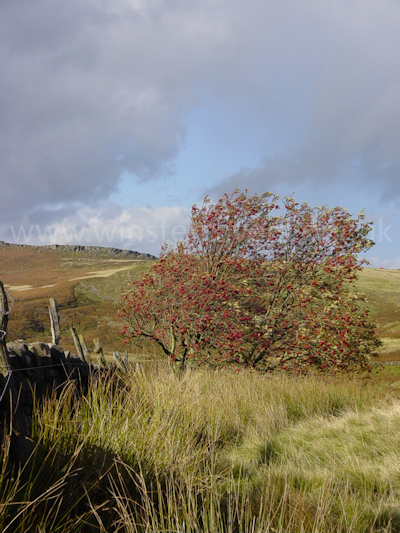
I want to link a picture of the moors, so if I find some good ones I'll post them. The one above is from here, just from a Google search, and it'll do for now. All mine are in summer (the heather blooming purple is beautiful), which doesn't quite get the bleakness of the landscape when it's cold and rainy, as it was when I was back a few days ago.
Here's some stuff about the accent-alliterative metre, which is another interesting non-iambic form, and which apparently influenced GMH a lot.
Deep in the winter, when the wild winds whistle and whisper.
Far in the distance bleak earth met bleary sky, though beforehand
Sunshine had seen the soft, green valley blooming, and kissed her.
We were alone, the moor and I, and the limitless grey sky;
I walked the unmarked path that the dark earth murmured in silence.
Never a soul I saw as dampening grey-tinged mist rolled by,
Going I knew not where with the chilling vagueness of violence.
After hours, it seemed, I found the mists started clearing
And I saw my path led on to the edge of a dark wood.
Sheer black walls of trees stared down, and seemed to be sneering,
Daring me to venture into their dank depths, and I stood.
Long I delayed, unsure, while overhead clouds started breaking;
Still no decision had I on the sharp tug of my waking.
Background
This was my test case for hexameter sonnets, which I came up with while in Cornwall (a daydream, not a night dream). The moors (the proper way to say 'moor' is to rhyme with 'poor', as in very conservative RP and in Northern English accents) in question are the ones near where I live, on the outskirts of Sheffield, just into Derbyshire. They are pretty but definitely not tame - they're the ones Jane Eyre was afraid she'd die on, if you know the book.
Technically
Like I say, this was the first hexameter sonnet I wrote, which I was rather pleased with. I think the metre lends itself quite well to alliteration, perhaps reminiscent of the Old English accent-alliterative metres (which I've played with a bit, and might post if I find a good one) used in things like Beowulf. Looking at these two again, the style feels a little verbose - more in this than in Moonlit, and in my initial writing in hexameter generally. The inversion in the last line ("had I") kind of sums it up - something you just wouldn't say. That's always the danger in forms, generally - you can end up writing something unnatural. Poetic diction is license so far, but I like to keep things clear as much as possible, so people realise that anything else is deliberate - unlike people trying pentameter for the first time after reading too much Shakespeare who end up putting in a lot of "doth"s and "thou"s. (Both of which are fine, of course, provided you mean to do them.)
In case anyone wants to try a hexameter sonnet (email or post in comments, if you're brave), a brief summation of how mine work:
- The metre is stress-based dactylic hexameter (six stressed syllables in a line with one or two unstressed syllables between, and the last two stress groups always Adonic (dáctyl then spóndee, DUM-dee-dee DUM-dum))
- The structure is the same as a Shakespearian sonnet, three quatrains and a volta couplet rhyming ABAB CDCD EFEF GG (with the volta "turning away" or evolving from the rest of the sonnet in subject matter)
- The lines which rhyme according to the rhyme scheme have the last stress group rhyming (all feminine rhymes), and the same scansion (same positioning of unstressed syllables).
Links
Here's some stuff about the accent-alliterative metre, which is another interesting non-iambic form, and which apparently influenced GMH a lot.
Saturday, 8 January 2011
Moonlit
Faceless cities' repetition echoes and flickers -
Gone in the blink of an eye, then renewed as if nothing had happened;
Sit immobile by the window. Train carriage bickers,
Snarls as it ploughs into midnight and winds through the lines on the map-land.
People asleep never notice the rumbling ride through the moonlight -
Far too tired to watch the criss-crossing roads and the street-lamps
Weaving their way far below in the mish-mash maze of their dark night,
Or to watch their own reflections gaze in with a rapt glance.
Bright lights keep me awake, though my sore eyes cry out for sleeping -
Let them, while I dream of sitting and watching and thinking
On a train late at night where the place names flutter by, sweeping
Onwards, home, to my warm bed and to restfully sinking.
But how could I sleep, when my head is still rolling and reeling
From her sweet, sharp words and the thunderstruck awe of their feeling?
for J
Background
This was written on a train while I was nearly asleep, typing the lines into my phone as they came to me. I'd been visiting the "her" in question earlier that day, and I like how that sort of aura of having just visited someone you love pervades it. Well, I think it does. Death of the author and all that. (I'll probably talk about that more later.)
Technically
Technically - and as you may have noticed from the rhyming (incidentally, "street-lamps"/"rapt glance" works if you have a Northern accent, which I do indeed have) I do like forms - this is a Shakespearian sonnet written in dactylic hexameter, a form I'm pretty sure no-one else has bothered with.
The way I use hexameter, basically, is that there are six stresses in a line, with one or two unstressed syllables after, the last two stress groups always going DUM-dee-dee DUM-dum. Here's the first quatrain with stress groups marked:

You might notice that the stress groups (feet, technically) with three syllables (dactyls, hence the metre name - the word comes from the Greek for finger, which goes long-short-short from your knuckle) and the ones with two syllables (spondees, from the Greek for libation, as far as I can tell - it scans as itself, anyway, like dáktylos did) match in rhyming lines - if you go through the rest of the poem and look where the stresses come, you'll hopefully see that this is generally true - at least look how the rhyming lines are roughly the same length (stress in lines can be fairly subjective, I've found).
Dactylic hexameter has been used for epic poetry in Latin and Greek (Homer, Virgil, Ovid all wrote in it, and in Latin it became effectively the default metre for poetry, like iambic pentameter in English), and has a nice rhythmic flow. I find the relative freedom of the number of syllables brings out the stresses nicely, and the fixed clósing Adónic (see what I did there...) acts like a chorus in a song, gaining momentum through repetition. It's no accident it's the stuff they built huge epic poems out of - the rhythm marches (to me it goes DUM-dum DUM-dee-dee DUM-dum, one-two one-one-two one-two) rather than bounces (DUM-di DUM-di DUM-di-di DUM-di), a feature rare in iamb-dominated English versification.
Oh, and take note of the DUM-dee-dee DUM-dum rhythm. Its technical name is an Adonic, after Sappho's use of it to go "Ó, ton Adónin!" ("O, for Adonis!", as Stephen Fry suggests for a translation into the same figure) in praise of the particular youth. Wait for fúrther discússion...
And don't worry, they won't all be this long.
Links
Well, if you're interested in a more formal definition of how dactylic hexameter works in Latin and Greek (quantitive rather than accentual), the Wikipedia page is helpful to start with. WP is generally good for the basics of anything, versification being no exception.
If you're not familiar with the strictures of the Shakespearian sonnet, again, Wikipedia is your friend.
All this talk of strongly stress-based metres with variable numbers of unstressed syllables may put you in mind of Gerard Manley Hopkins and his sprung rhythms - he is a favourite poet of mine, but I only properly came across his stuff after I wrote most of this. Honest... Look at Pied Beauty, which does everything I could ever hope to do much better than I ever could - the mark of really good poetry; it has to break your heart a little.
Thursday, 6 January 2011
Please allow me to introduce myself...
Hi, I'm Blindheight.
Well, that's not my actual name, but you know.
I intend (and I'm probably going to end up doing something moderately to totally different) to put up some of the things I've written that I like and that I think other people might like as well; whether or not they're actually any good at all I don't know. Being massively attention-seeking I've shown things I've done to some people who seem to have liked them. I guess that if you don't, you can always go and read something else.
So, initially I think I'm going to put up some poems, because they're short, a few times a week. I'll also add some background stuff to do with them, which you should feel free to ignore. We'll see how it goes.
So, I'm Blindheight. I'm not be a man of wealth or particular taste, but I do have some stuff I'd like you to see, with some background on it. I reserve the right to be as evasive as I like and provide random rambly details that interest pretty much only me - like I said, feel free to ignore them.
Woop woop.
Subscribe to:
Comments (Atom)